
Ah, pectin — the soft whisper of nature’s architecture, the reason jam shimmers, fruit gels hold their shape, and sauces gain their silky embrace. 🍊✨
Let’s open this natural marvel and see how chemistry, botany, and craftsmanship unite to turn fruit into form.
🌿 1️⃣ What Is Pectin?
Pectin is a natural polysaccharide — a complex carbohydrate — found in the cell walls of plants, particularly abundant in fruits.
It acts as the cement that binds plant cells together, giving firmness and structure to leaves, peels, and pulps.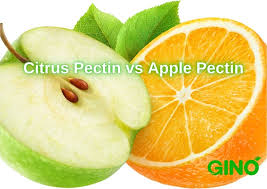
Chemically, pectin is composed mainly of:
α-(1→4)-linked D-galacturonic acid units,
partially methyl-esterified (influencing gelling strength),
with side chains of rhamnose, arabinose, and galactose.
In simpler words: pectin is nature’s gel-maker, the molecular artist behind every smooth jam, jelly, and fruit filling.
🧪 2️⃣ The Dual Nature of Pectin: Structure & Function
| Type | Degree of Esterification (DE) | Key Behavior | Typical Use |
|---|---|---|---|
| High Methoxyl (HM) Pectin | >50% | Gels with sugar & acid | Fruit jams, jellies |
| Low Methoxyl (LM) Pectin | <50% | Gels with calcium ions | Low-sugar jams, dairy desserts |
👉 The higher the esterification, the more it depends on sugar and acid.
👉 The lower the esterification, the more it bonds with calcium ions, making it perfect for low-calorie or neutral pH systems.
🍋 3️⃣ Natural Sources of Pectin
Pectin is present in most plant tissues, but citrus peels and apple pomace are the richest and most sustainable sources for commercial use.
| Plant Source | Pectin Content (% of fresh weight) | Extraction Yield (typical) |
|---|---|---|
| Lemon peel | 25–30% | High |
| Orange peel | 20–25% | High |
| Apple pomace | 10–15% | Medium |
| Sugar beet pulp | 10–12% | Medium |
| Sunflower head residue | 5–8% | Low |
These sources come from food industry by-products — a beautiful example of upcycling: waste peel becomes valuable ingredient.
⚗️ 4️⃣ How Pectin Is Naturally Extracted
Extraction is both art and precision chemistry.
Here’s how it’s done in the most natural, food-safe way:
🧾 Step-by-Step Process
1️⃣ Raw Material Preparation
Dried citrus peel or apple pomace is ground into small particles.
pectin Moisture is adjusted to optimize extraction.
2️⃣ Acid Extraction
The material is treated with mild acid (citric or nitric acid) at 60–90°C.
Acid breaks down protopectin (insoluble) into soluble pectin.
3️⃣ Filtration & Concentration
The pectin solution is separated from solids and concentrated by evaporation.
4️⃣ Precipitation
Pectin is precipitated using ethanol or isopropanol, which separates it from the solution.
5️⃣ Washing & Drying
The pectin is washed to remove acid and sugar residues, then dried at low temperature.
6️⃣ Milling & Standardization
The dried pectin is ground into fine powder and standardized for gelling strength.
👉 The result: a pure, plant-based hydrocolloid, natural and biodegradable.
🌸 5️⃣ Pectin’s Role in Food Systems
| Function | Application Example | Effect |
|---|---|---|
| Gelling agent | Fruit jams, marmalades | Creates firm texture |
| Thickener | Yogurts, sauces, dressings | Adds body and stability |
| Stabilizer | Juices, milk drinks | Prevents separation |
| Fat replacer | Low-fat spreads, desserts | Smooth mouthfeel |
| Encapsulating agent | Vitamin or flavor microcapsules | Protects sensitive ingredients |
In confectionery and dairy, LM pectin stabilizes proteins; in jams, HM pectin works with sugar and acid to make that perfect set.
🧫 6️⃣ Chemical Beauty: How Gelation Works
The gel network forms when:
Pectin chains align,
Hydrogen bonds and hydrophobic interactions occur,
Water becomes trapped in the network.
For HM pectin:
Needs pH 2.8–3.5
Requires >55% sugar to dehydrate chains and enhance bonding
For LM pectin:
Works in neutral pH, with Ca²⁺ ions bridging the carboxyl groups, forming “egg-box” structures. 🥚✨
🌍 7️⃣ The Market & Sustainability View
Global pectin market: >USD 1.5 billion (2025), growing at 6–7% annually.
Citrus pectin dominates, followed by apple pectin.
Demand is rising for clean-label, vegan, and natural hydrocolloids.
Pectin production supports fruit-processing waste reduction, making it both eco-friendly and profitable.
Tynod Chemistry works closely with trusted citrus processors to ensure consistent, high-purity pectin — tailored for both food and pharmaceutical formulations.
🍯 8️⃣ Why Manufacturers Choose Tynod Chemistry’s Pectin
✅ Derived from natural citrus or apple sources
✅ High gelling strength and clarity
✅ Excellent stability in heat and acid conditions
✅ Non-GMO, vegan, allergen-free
✅ Custom grades (HM, LM, amidated LM) for any application
✅ Fast delivery and competitive global pricing
Our pectin doesn’t just thicken or gel — it transforms textures into experiences.
From a clear fruit jelly to a creamy yogurt swirl, it defines consistency with elegance.
✨ 9️⃣ In Essence
Pectin is the poetry of plants translated into texture —
a molecular bridge between botany and gastronomy.
It reminds us that even the discarded peel of an orange
can be reborn as a crystal-clear gel of pure beauty. 🍊💫
“Nature gives pectin as structure; chemistry refines it as art.”
— Tynod Chemistry